
Could you have ADHD without knowing it?
Yes, that is a real possibility. Especially if you are among the 10% most gifted, you can conceal a diagnosis in different ways. This is because you are better at adapting, devising strategies and compensating for the disadvantages of for instance ADHD. Conversely, a diagnosis can also conceal your high IQ because you may have been unable to complete a longer period of studies and make use of your cognitive abilities.
A concealed diagnosis means that you are not only at work – you are constantly working overtime. And it might just be a question of time before you fall apart.
An ADHD diagnosis can sometimes lie dormant, as long as you are generally okay. In the precise moment something out of the ordinary happens in your private life, while you are also under pressure at work, there is a great risk that you will hit rock bottom and be signed off due to stress – because no one has a better label for the state of burnout and breakdown you are in. In actual fact, your system has been completely overloaded.
What are the signs of an ADHD diagnosis?
According to Psykiatrifonden, symptoms of ADHD fall into three groups:
- Inattentiveness – you find it difficult to focus and concentrate on one thing at a time
- Hyperactivity – your energy levels are so high that your body feels restless, you have jittery hands and/or feel agitated inside
- Impulsivity – you are very willing to take risks and make fast/hasty decisions, just as you spontaneously express your (emotional) reactions
The personality test measures the following:
- Inattentiveness as a particularly low score for concentration – less than 20 out of 100
- Hyperactivity as a very fast pace – more than 80 out of 100
- Impulsivity as a particularly low score for planning and self-control – both less than 20 out of 100
This can also be seen as a very high willingness to take risks – more than 80 out of 100
How this is expressed varies greatly for each individual, as it depends on the severity of the diagnosis as well as your IQ, your personal resources and your performance pattern. The interaction with a diagnosis is complex, as in some ways it may be an advantage as well as a disadvantage.
If you have a high IQ, you will probably “only” be able to recognise two of the three symptoms – and for that reason you are borderline.
Please note: The personality test is not a clinical test, and so your scores should be measured against your general well-being. If you are able to recognise all/most of the symptoms and feel unhappy, it is recommended that you talk to your GP.
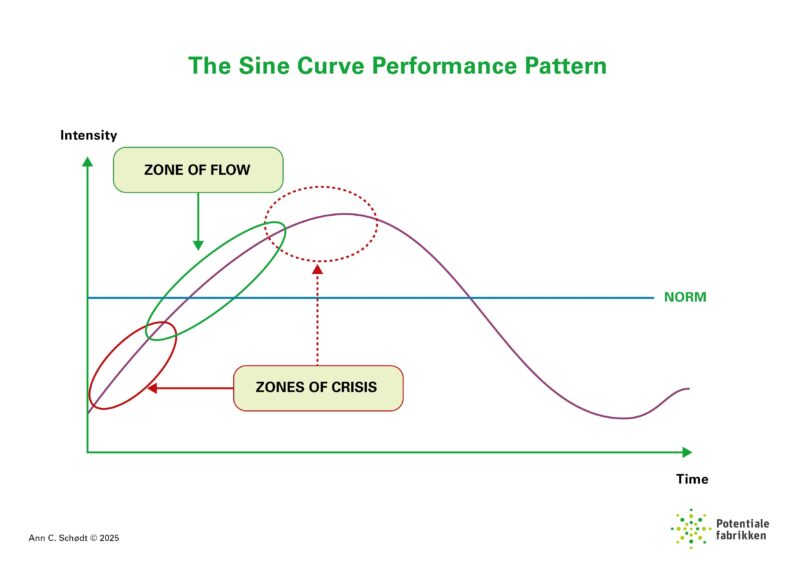
The sine Curve Performance Pattern
ADHD and the sine curve performance pattern
If you mainly follow the sine curve performance pattern, your energy comes in waves like an alternating current. You do your best work and are most focused when you have a specific, short-term goal.
ADHD can positively enhance your ability to perform at your best so that you work quickly and intensively when required, for example if dealing with crisis management and various kinds of “fire-fighting”.
On the other hand, your tendency to be overly optimistic about how much time is available and your lack of planning may be heightened. An ADHD diagnosis can make it particularly difficult for you to arrive at work on time and adhere to deadlines. You may experience inner chaos, constantly feeling that you are trailing behind, and it does not exactly help that you lose your sense of time when you are working.
In this combination, one of the side effects of your high IQ may be that you are keenly aware that you should be better at planning, arriving on time etc. You then end up having a bad conscience, a feeling of inadequacy and low self-esteem and/or being affected by the Impostor Phenomenon because you are struggling with your high expectations of yourself at the same time.
If you have to take part in particularly important meetings, this can be very stressful for you, leading to difficulties sleeping and anxiety-like symptoms as the meeting approaches.

The Square Curve Performance Pattern
ADHD and the square curve performance pattern
If you mainly follow the square curve performance pattern, you are either “on” or “off”. You do your best work and are most focused when you are in flow. On the other hand, this can make you forget everything around you.
The marked differences between whether you are in flow or not may be almost extreme when combined with an ADHD diagnosis. You can either be hugely efficient with hyperactivity and hyperfocus if you have a task that interests you and makes sense, or you can hit the “Wall of Death” and come to a complete halt if you get a routine task for which you have no enthusiasm whatsoever.
When a high IQ is added to this, you have the same scruples as people who follow the sine curve performance pattern, and you also feel lazy and incompetent when you cannot get things done. But getting started is impossible, and it stays that way. Instead, you excel in the secret championship in procrastination and probably believe that you could reach the top spot at both national and international level completely unchallenged.
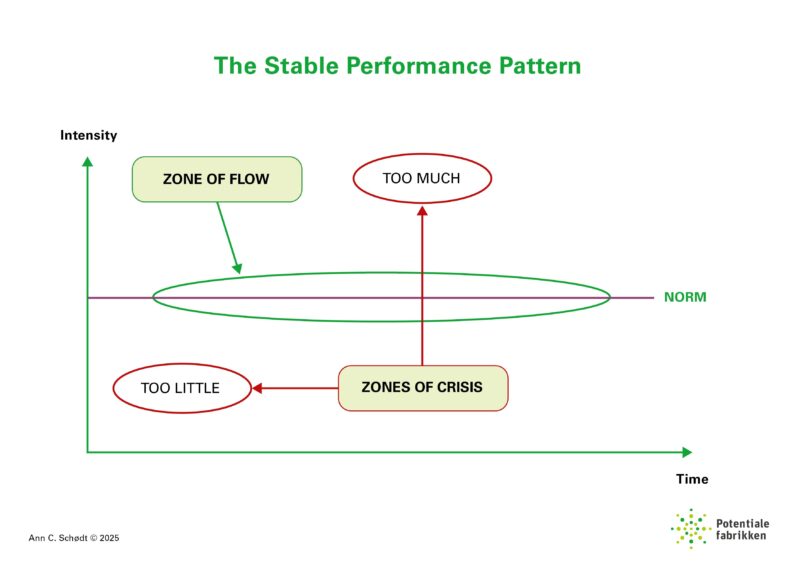
The Stable Performance Pattern
ADHD and the stable performance pattern
If you mainly follow the stable performance pattern, your energy is like a direct current that makes you work in a stable and conscientious way every day. In contrast to people who follow the sine curve or square curve performance pattern, you have no problem getting started – as long as there is an even flow of tasks you can dive into.
The hyperactivity and fast pace from ADHD may turn you into a Duracell bunny, constantly performing at a high level. However, winding down after achieving a top performance can be difficult and give you trouble sleeping. You find it almost impossible to relax, so your nearest and dearest have to put up with you always running around frantically and doing several things at once.
With a high IQ, you are probably able to cover up an ADHD diagnosis with an extreme level of commitment and self-control. However, the hyperactivity and attention deficit will surface as impatience and forgetfulness, which others may find confusing and annoying. You probably turn up the control a notch, blame yourself and may become more domineering and/or pedantic in a desperate attempt to get a hold of yourself and as many things in your sphere as possible.
Be self-aware and take care of your resources
The purpose of this post is not to say that everyone should get a diagnosis. On the contrary, my hope is that you will gain a greater understanding of yourself, allowing you to have realistic expectations, be self-aware and take care of your resources – before it is too late.
With the sine curve performance pattern, you must ensure that you recover after each top performance. Take a break, talk to a colleague, go for a walk or play a game on your phone.
With the square curve performance pattern, you need to accept that you cannot be super-efficient at all times. Being in flow 1-2 times per week is enough, since you will literally be burning the candle at both ends when you are in flow. The rest of the time you should actually do as little as possible in order to recharge your batteries.
With the stable performance pattern, you must make sure that you wind down. At work, you can “relax” with some less demanding routine tasks. In the evening, you might benefit from yoga, meditation, writing a diary or reading a book.
Since everyone follows elements from at least two performance patterns, you can try things out until you find what works best for you. Deep breaths and breathing exercises are also helpful for everyone.
Test your performance pattern
Please note: You will always need to consult a psychiatrist for diagnostic evaluation. This post was written solely to provide you with more self-awareness and a basis for your own reflections on this.
See also:
Do you have a high IQ and/or ADHD?
Does your high IQ conceal an ADHD diagnosis?
Discover more from Potential Factory
Subscribe to get the latest posts sent to your email.

