

Do you have a high IQ or are you averagely intelligent?
If you’re unsure, it’s quite likely that your IQ is higher than you think. Having worked professionally with intelligence tests and developing the potential of the 10% most gifted since 2012, I see a clear trend:
gifted people do not believe that they are gifted, while those of high average intelligence are often convinced that they are more intelligent than the test shows.
This peculiar difference may be because of who they’re comparing themselves to:
people with a high average IQ compare themselves to those of average intelligence and may, quite rightly, conclude that they are more intelligent than them.
However, the gifted (top 10%) are inclined to compare themselves to others who are even more gifted, and then conclude – incorrectly – that they are not particularly gifted themselves. Therefore, a number of gifted people struggle with impostorism, where they overestimate others and underestimate themselves.
Here are the links to two tests, which can reveal how high your IQ actually is:
- Logical perception (Mensa’s website)
- More general IQ test (People Test Logic)
If you don’t feel ready to take an IQ test, you can get an indication by using this self-assessment, which is based on the typical characteristics of gifted people:
Are you impedingly intelligent?
4 differences between having a high IQ and a normal IQ
Basically, the differences between being averagely intelligent and having a high IQ are evident in four ways:
- Speed
- Comprehension
- Work discipline
- Communication and adaptability
This is not to say that this always applies to everyone – there may be individual differences within all four areas, which can make the overall picture less clear and consequently create doubt.
If you haven’t yet taken an IQ test, you may have a blind spot and believe that you are averagely intelligent.
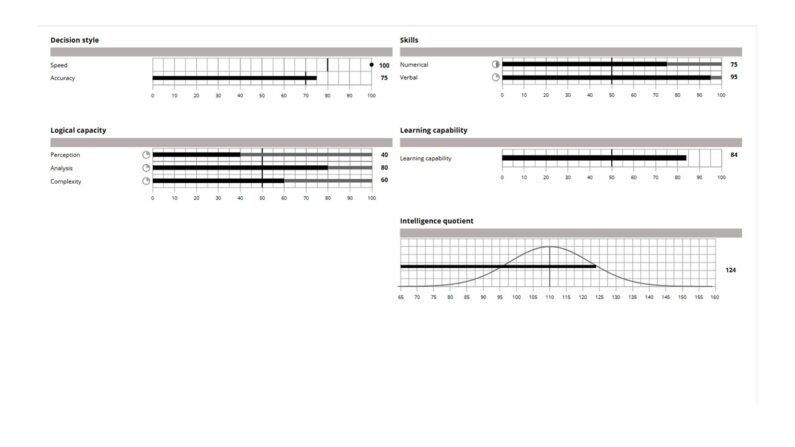
Example of IQ test
1. High IQ and high speed
The most visible and obvious difference lies in the element of speed: quite simply, gifted people are quicker at learning new things.
In the intelligence test, this reveals itself as a learning ability that is well above 50, which is the average for the norm group of managers and white-collar workers aged 20-65 years.
You are bound to remember a fellow student who hardly ever opened a book, but when they finally did, they could quickly skim the pages and extract the essential information. Between you and me, that can seem pretty annoying when you’ve spent a long time reading it, but that’s just how it is:
gifted people can acquire new knowledge more quickly.
2. High IQ and quick comprehension
When someone has a high IQ, this may be evident in several ways. Gifted people typically find it easier to understand contexts and greater complexity because they have a higher level of abstraction and can detect patterns relating to the information they receive.
This may be somewhat due to them having stored a greater amount of knowledge in several areas, and when they hear or read something new, they have more opportunities to link the new information to something they already know.
In practice, this means that they find things easier to understand and that they need less time to place new knowledge in a context. This presents gifted people with advantages in terms of complex problem-solving.
Conversely, some of them may have such a high level of abstraction that they tend to overcomplicate matters. This means that they often find it difficult to explain simple things to others, just as they are constantly distracted by exceptions instead of focusing on the general rule.
3. High IQ and differences in effort
If you look at a random 9th grade class at any school in Denmark, already at this stage there will be clear differences in the students’ efforts:
averagely intelligent children are used to having to do their homework to keep up. As a result, they more often have good work habits, and there is a reasonable proportionate relationship between their efforts and their marks, or they tend to do well in exams.
For gifted children, the scenario is less clear-cut. The highly gifted children (top 2%) have often made it through primary and lower secondary school without needing to do their homework, so they make limited efforts, but nevertheless they may get good marks in their exams.
Among bright children (top 3-10%), there may be some who put in the same poor effort as the highly gifted children and get more average marks, alongside more hard-working kids who may have a good correlation between their efforts and their high marks.
Finally, there may be gifted children who get good marks in the subjects that interest them, and more average or low marks in those that don’t interest them. This may be due to their performance pattern.
Consequently, there is not necessarily a correlation between efforts and results.
Gifted people find many things easier to do, and this is one of the reasons why as adults they may feel lazy because they haven’t made any real effort. Many of these individuals are affected by impostorism – a type of inferiority complex that makes them consistently underestimate their own talents.
4. High IQ – communication and adaptability
The final difference is often confused with social skills. There seems to be an assumption that if you have a high IQ, you cannot be socially intelligent at the same time. However, these two things are not related.
Gifted people can be extroverted, open and find it easy to start talking to others. They can also be introverted, reserved and find small talk difficult. They can be empathetic and find it easy to imagine how others are feeling, and they can be less empathetic – in exactly the same way as averagely intelligent people. Because this depends on their personality traits, not their IQ.
These differences are related to another factor:
Communication is difficult
More often, gifted people find that others (= the averagely intelligent) don’t understand what they’re saying. Therefore, they’ve got used to rephrasing and repeating themselves when they need to convey a message or express an opinion. This may make some of them doubt their own intelligence or even feel stupid – because they believe that ‘it must be me there’s something wrong with’.
Gifted people don’t really fit in anywhere.
When you’re among the 5% most gifted, you think differently and faster than 95% of those you meet in any given context. This is usually evident in you having different interests and therefore being unable to join in when others talk about fashion, football, celebrities or reality TV, or whatever most people at work are into these days. Furthermore, gifted people can also be very different from each other, and their interests may vary greatly.
At the same time, an automatic selection process occurs when we start a conversation with someone we don’t know:
“like attracts like”, and we have the best and most effortless chats with those who are on the same level as ourselves in terms of intelligence.
Also see:
- 10 signs that you are more gifted than you think
- High IQ and being far too honest
- 4 reasons why gifted people do not progress in their careers
Discover more from Potential Factory
Subscribe to get the latest posts sent to your email.

